
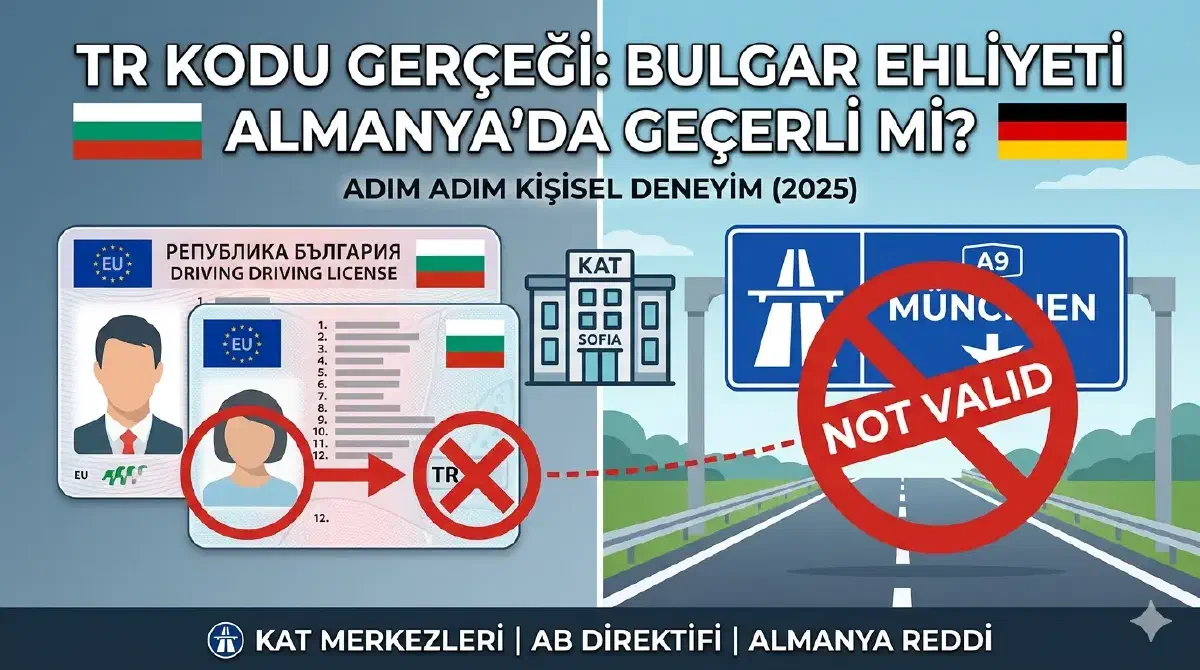
Overview#
The dream of a seamless transition to life in Germany often comes with practical challenges, and navigating the driving license system is one of the most prominent. For many Turkish-origin individuals, especially those with dual Turkish and Bulgarian citizenship, a seemingly ingenious “shortcut” emerges: converting their Turkish driving license to a Bulgarian one, then expecting full recognition in Germany due to Bulgaria’s EU membership. This strategy aims to bypass Germany’s notoriously complex and expensive driving license exchange process, which often requires retaking significant parts of the driving test.
In Germany, the official stance on non-EU driving licenses is clear: they are generally valid for the first six months (extendable up to 12 months in some cases) of residency, after which they must be exchanged for a German license. For licenses from “third countries” (non-EU/EEA), this usually involves a theory test and a practical driving test, incurring significant costs and time. Bulgarian driving licenses, being EU-issued, are theoretically fully recognized in Germany and can be exchanged without further tests. This distinction fuels the belief that a Turkish-to-Bulgarian conversion is a clever workaround.
This article is specifically for Turkish/Turkish-origin individuals who hold or are in the process of obtaining Bulgarian citizenship, and who currently possess a Turkish driving license. If you’re planning to move to Germany and are considering this exact route – converting your Turkish license in Bulgaria with the expectation of using it freely in Germany – then this guide is crucial. I walked this path myself, invested considerable time and money, and experienced the full reality of this process. My aim is to provide you with a first-hand, detailed account to save you from similar frustrations and misguided efforts. Let’s uncover why this seemingly logical workaround falls short of expectations when it meets German bureaucracy.
Step-by-Step Process: The Bulgarian License Journey#
Converting a Turkish driving license to a Bulgarian one requires several steps, each with its own set of requirements and potential hurdles. My journey through this process illuminated how bureaucratic complexities can turn a simple task into a multi-stage challenge, especially when compounded by language barriers.
Step 1: Establishing Bulgarian Residency and Address Registration#
Before you can even think about your driving license, you must establish active residency and have a registered address in Bulgaria. This is the foundational step for any official process in the country.
- Where: This process is handled by the local municipality (Obshtina) or the regional police department (Regionalna direktsiya na MVR) where you intend to reside.
- How: You’ll need proof of residence (e.g., rental agreement, property ownership), your Bulgarian ID card (лична карта) or passport, and often a declaration of address.
- Duration: Registration can be relatively quick (a few hours to a day) once you have all the documents, but obtaining proof of residence itself might take longer.
- Watch out: Ensure your address is officially registered in the national system, as driving license offices will verify this electronically. Without a valid, active registration, your license application will be rejected immediately.
Step 2: Obtaining a Medical Certificate#
A medical certificate is mandatory to confirm you are fit to drive. This step is generally straightforward in Bulgaria.
- Where: You can obtain this from any licensed general practitioner or medical facility (ДКЦ - Diagnostichno-konsultativen tsentar or similar) in Bulgaria. I personally obtained mine at a smaller facility near Kardzhali.
- How: The examination is typically brief and basic, focusing on general health. You might be asked about your medical history, vision, and hearing. In my experience, it was more of a formality than an extensive check-up.
- Duration: Usually issued on the same day.
- Watch out: Make sure the certificate explicitly states it is suitable for driving license renewal/issuance. Language might be an issue if you’re in a smaller town, so preparing some basic Bulgarian phrases or having a translator app handy could be useful.
Step 3: Gathering Required Documents for KAT#
Preparation is key to avoid multiple trips and delays. Ensure you have all the necessary documents in the correct format.
- Original Turkish License & Photocopies: Bring your physical Turkish driving license. Make several photocopies of both sides.
- Bulgarian ID Card/Passport: Your valid Bulgarian identification.
- Passport-Sized Photos: Usually 2-3 recent biometric passport photos.
- Medical Certificate: The one obtained in Step 2.
- Proof of Address: A document confirming your current registered address in Bulgaria (e.g., certificate from the municipality).
- Interpreter: If you do not speak Bulgarian, an interpreter is essential. While not explicitly a “document,” their presence is critical for a smooth application.
Step 4: Application at a Sofia KAT Center#
This is where the rubber meets the road. Navigating the KAT centers can be challenging due to bureaucracy and language barriers.
- Where: KAT (Kontrol na Avtomobilniya Transport) centers handle traffic and license matters. In Sofia, there are multiple centers. You might need to go to a specific one depending on your registered address, so it’s wise to inquire beforehand. A general Google Maps search for “KAT Sofia” might show several locations, but confirming the correct one is vital. For example, some common ones are in Druzhba or near Vitosha Blvd. (Always search “KAT Sofia” on Google Maps to find current locations and opening hours).
- How: This is an in-person application. You’ll take a number, wait for your turn, and present your documents to an officer.
- Appointment: Appointments are generally not required for this type of service, it’s typically a walk-in system, leading to potentially long waiting times.
- Watch out:
- Language Barrier: This was my biggest hurdle. Many officers do not speak English. Do not attempt this without a Bulgarian speaker or a professional interpreter. My first two attempts failed purely due to this.
- Document Gaps: Even minor missing items (like an extra photocopy) can send you back to the end of the line.
- Human Factor: The system heavily relies on the discretion and willingness of the individual officer. Be polite, patient, and prepared for potential rejections based on minor details.
- Forms: Be ready to fill out forms in Bulgarian. An interpreter will be invaluable here.
Step 5: The 30-Day Waiting Period#
Once your application is successfully submitted, a waiting period begins.
- Duration: The standard waiting period for a new Bulgarian license is approximately 30 days.
- What to do: You will be given a document confirming your application. Keep this document safe, as it is essential for collecting your new license. During this time, you can legally continue driving with your Turkish license, as it hasn’t been surrendered yet.
Step 6: License Collection#
The final step in Bulgaria, where you receive your new EU-format driving license.
- Where: You must return to the same KAT center where you submitted your application.
- How: Present the document you received during application. Your Turkish license will be collected, and your new Bulgarian license will be issued.
- Watch out: Again, the language barrier might be present. Be prepared to use an interpreter if necessary. Immediately upon receiving the license, check the back for the “TR-XXXXX” code. This code is the crucial detail that changes everything for its validity in Germany.
Required Documents#
Having all your paperwork in order is crucial for a smooth process in Bulgaria. Here’s a breakdown of the documents needed, focusing on what I used and what is typically required.
| Belge (Document) | Nereden Alinir (Where to Obtain) | Aciklama (Explanation) |
|---|---|---|
| title: “Can You Drive in Germany with a Bulgarian License? | Turkish→Bulgarian Transfer Reality (2026)” | |
| date: 2026-03-15 | ||
| draft: false | ||
| images: [“img/bulgarehliyet/bulgar-ehliyeti-almanya.webp”] | ||
| featureimage: “img/bulgarehliyet/bulgar-ehliyeti-almanya.webp” | ||
| description: “Does converting a Turkish license to a Bulgarian one work in Germany? KAT centers, TR code, EU directive and first-hand experience. A clear answer for Bulgarian citizens.” | ||
| tags: [“bulgarian license germany”, “turkish license bulgaria”, “driving license transfer bulgaria”, “KAT sofia”, “bulgaria license process”, “eu driving license conversion”, “turkish bulgarian citizenship”, “germany driving license solution”, “führerschein bulgarien”, “license TR code”, “bulgaria KAT center”, “dual citizenship license”, “eu directive driving license”, “germany expat license”, “bulgaria sofia license”, “turkish passport bulgaria”, “germany 2025 license”, “shortcut driving license”, “bulgarian citizen germany”, “eu führerschein türkei”] | ||
| categories: [“almanya”] | ||
| summary: “I obtained Bulgarian citizenship and converted my Turkish license to a Bulgarian one. Sofia KAT centers, mandatory interpreter, 30-day wait and then the clear answer from Germany: no, it doesn’t work. The EU directive doesn’t allow it.” | ||
| translationKey: “post-bulgar-ehliyet” |
Overview#
The dream of a seamless transition to life in Germany often comes with practical challenges, and navigating the driving license system is one of the most prominent. For many Turkish-origin individuals, especially those with dual Turkish and Bulgarian citizenship, a seemingly ingenious “shortcut” emerges: converting their Turkish driving license to a Bulgarian one, then expecting full recognition in Germany due to Bulgaria’s EU membership. This strategy aims to bypass Germany’s notoriously complex and expensive driving license exchange process, which often requires retaking significant parts of the driving test.
In Germany, the official stance on non-EU driving licenses is clear: they are generally valid for the first six months (extendable up to 12 months in some cases) of residency, after which they must be exchanged for a German license. For licenses from “third countries” (non-EU/EEA), this usually involves a theory test and a practical driving test, incurring significant costs and time. Bulgarian driving licenses, being EU-issued, are theoretically fully recognized in Germany and can be exchanged without further tests. This distinction fuels the belief that a Turkish-to-Bulgarian conversion is a clever workaround.
This article is specifically for Turkish/Turkish-origin individuals who hold or are in the process of obtaining Bulgarian citizenship, and who currently possess a Turkish driving license. If you’re planning to move to Germany and are considering this exact route – converting your Turkish license in Bulgaria with the expectation of using it freely in Germany – then this guide is crucial. I walked this path myself, invested considerable time and money, and experienced the full reality of this process. My aim is to provide you with a first-hand, detailed account to save you from similar frustrations and misguided efforts. Let’s uncover why this seemingly logical workaround falls short of expectations when it meets German bureaucracy.
Step-by-Step Process: The Bulgarian License Journey#
Converting a Turkish driving license to a Bulgarian one requires several steps, each with its own set of requirements and potential hurdles. My journey through this process illuminated how bureaucratic complexities can turn a simple task into a multi-stage challenge, especially when compounded by language barriers.
Step 1: Establishing Bulgarian Residency and Address Registration#
Before you can even think about your driving license, you must establish active residency and have a registered address in Bulgaria. This is the foundational step for any official process in the country.
- Where: This process is handled by the local municipality (Obshtina) or the regional police department (Regionalna direktsiya na MVR) where you intend to reside.
- How: You’ll need proof of residence (e.g., rental agreement, property ownership), your Bulgarian ID card (лична карта) or passport, and often a declaration of address. The specific requirements can vary slightly by municipality, so it’s best to check with the local authorities.
- Duration: Registration can be relatively quick (a few hours to a day) once you have all the documents, but obtaining proof of residence itself might take longer.
- Watch out: Ensure your address is officially registered in the national system, as driving license offices will verify this electronically. Without a valid, active registration, your license application will be rejected immediately. This step is often overlooked by those seeking a quick solution.
Step 2: Obtaining a Medical Certificate#
A medical certificate is mandatory to confirm you are fit to drive. This step is generally straightforward in Bulgaria.
- Where: You can obtain this from any licensed general practitioner or medical facility (ДКЦ - Diagnostichno-konsultativen tsentar or similar) in Bulgaria. I personally obtained mine at a smaller facility near Kardzhali, demonstrating that you don’t necessarily need to be in a major city like Sofia.
- How: The examination is typically brief and basic, focusing on general health, vision, and hearing. In my experience, it was more of a formality than an extensive check-up, costing around 30 leva (~15 EUR).
- Duration: Usually issued on the same day.
- Watch out: Make sure the certificate explicitly states it is suitable for driving license renewal/issuance. Language might be an issue if you’re in a smaller town, so preparing some basic Bulgarian phrases or having a translator app handy could be useful. No specific translation or apostille was required for this document, as it was issued directly in Bulgaria.
Step 3: Gathering Required Documents for KAT#
Preparation is key to avoid multiple trips and delays. Ensure you have all the necessary documents in the correct format. This list is a consolidation of what I learned through trial and error.
- Original Turkish License & Photocopies: Bring your physical Turkish driving license. Make several photocopies of both sides, ideally three sets, just in case. They will take your original Turkish license upon collection of the Bulgarian one.
- Bulgarian ID Card/Passport: Your valid Bulgarian identification document (лична карта).
- Passport-Sized Photos: Usually 2-3 recent biometric passport photos. These can often be taken at photo booths or small shops near the KAT centers.
- Medical Certificate: The one obtained in Step 2.
- Proof of Address: A document confirming your current registered address in Bulgaria (e.g., certificate from the municipality).
- Interpreter: If you do not speak Bulgarian, an interpreter is essential. While not explicitly a “document,” their presence is critical for a smooth application and for understanding the various forms and questions. You’ll likely need to arrange this privately, as official interpreters are not typically provided by KAT.
Step 4: Application at a Sofia KAT Center#
This is where the rubber meets the road. Navigating the KAT centers can be challenging due to bureaucracy and language barriers.
- Where: KAT (Kontrol na Avtomobilniya Transport) centers handle traffic and license matters. In Sofia, there are multiple centers. You might need to go to a specific one depending on your registered address, so it’s wise to inquire beforehand. A general Google Maps search for “KAT Sofia” might show several locations, but confirming the correct one is vital. My experience involved being directed between different centers initially.
- How: This is an in-person application. You’ll take a number, wait for your turn (which can be long), and present your documents to an officer.
- Appointment: Appointments are generally not required for this type of service; it’s typically a walk-in system, leading to potentially long waiting times. My attempts involved taking a number and waiting for hours.
- Watch out:
- Language Barrier: This was my biggest hurdle. Many officers do not speak English. Do not attempt this without a Bulgarian speaker or a professional interpreter. My first two attempts failed purely due to this. I had to find a private interpreter (often found through local shops or acquaintances) who charged me for their time.
- Document Gaps: Even minor missing items (like an extra photocopy) can send you back to the end of the line. Double-check everything.
- Human Factor: The system heavily relies on the discretion and willingness of the individual officer. Be polite, patient, and prepared for potential rejections based on minor details or simply a lack of patience from the officer.
- Forms: Be ready to fill out forms in Bulgarian. An interpreter will be invaluable here, ensuring accuracy.
Step 5: The 30-Day Waiting Period#
Once your application is successfully submitted, a waiting period begins for the new license to be processed and printed.
- Duration: The standard waiting period for a new Bulgarian license is approximately 30 days. This is usually communicated at the time of application.
- What to do: You will be given a document confirming your application. Keep this document safe, as it is essential for collecting your new license. During this time, you can legally continue driving with your Turkish license, as it hasn’t been surrendered yet. You should not travel outside Bulgaria if you need your Turkish license for driving.
Step 6: License Collection#
The final step in Bulgaria, where you receive your new EU-format driving license.
- Where: You must return to the same KAT center where you submitted your application.
- How: Present the document you received during application along with your Bulgarian ID. Your Turkish license will be officially collected and likely destroyed or marked, and your new Bulgarian license will be issued.
- Watch out: Again, the language barrier might be present. Be prepared to use an interpreter if necessary. Immediately upon receiving the license, check the back for the “TR-XXXXX” code. This code is the crucial detail that changes everything for its validity in Germany. This small detail, often overlooked, is the ultimate reason why this “shortcut” fails.
Required Documents#
Careful preparation of documents is essential to avoid repeated visits and wasted time at the Bulgarian KAT centers. Here’s a comprehensive list of what you will typically need for the Turkish-to-Bulgarian driving license conversion.
| Belge (Document) | Nereden Alinir (Where to Obtain) | Aciklama (Explanation) |
|---|---|---|
| Active Turkish Driving License (Original) | Issued in Turkey | Your valid Turkish driving license. This will be physically surrendered when you collect your Bulgarian license. |
| Photocopies of Turkish Driving License | Home/Office or nearby copy shops | Make at least 3-4 clear photocopies of both the front and back of your Turkish license. |
| Bulgarian ID Card (Лична Карта) or Passport | Issued by Bulgarian authorities | Your official Bulgarian identification. Essential for proving citizenship and identity. |
| Proof of Registered Address in Bulgaria | Local Municipality (Община) | A formal document confirming your current active residency and address registration in Bulgaria. This is a non-negotiable prerequisite. |
| Medical Certificate for Driving | Any licensed Bulgarian medical facility | A certificate (Медицинско свидетелство за шофьор) stating you are medically fit to drive. As mentioned, a basic check-up, usually obtained on the same day. No translation or apostille needed for this, as it’s a Bulgarian-issued document. |
| Passport-Sized Photos | Photo booths, studios | 2-3 recent, biometric passport-sized photos. Ensure they meet standard passport photo requirements. |
| Application Form | KAT Center | This form will be provided at the KAT center. It is in Bulgarian, so an interpreter is crucial for accurate completion. |
| Application Fee Receipt | KAT Center / Bank | Proof of payment for the driving license processing fee. Usually paid at the KAT center itself via card, or sometimes at a nearby bank. |
Important Notes on Translations, Apostilles, and Notarization:
- For the conversion of a Turkish license in Bulgaria, I did not need any sworn translations, apostilles, or notarization for my Turkish driving license. The Bulgarian authorities were able to directly verify the Turkish license.
- All documents provided must be originals, with photocopies where requested. The medical certificate and proof of address will be Bulgarian-issued, so no extra certification is required for them within Bulgaria.
- The key challenge is the language. While documents themselves don’t require external certification, understanding and completing forms and instructions in Bulgarian requires either fluency or a reliable interpreter.
Costs & Timelines#
The financial and time investment in this process can be substantial, especially considering the outcome. My experience highlights that while official fees might seem low, the hidden costs add up quickly.
Official Fees (Bulgaria)#
| Islem (Action) | Ucret (EUR) (Estimated) | Sure (Duration) (Estimated) |
|---|---|---|
| Medical Certificate | ~15 EUR (30 BGN) | 1 day |
| Driving License Application | ~25 EUR (50 BGN) | 1 day |
| Total Official Fees | ~40 EUR | 2 days |
Note: The official fee for the license itself can vary slightly based on the type of processing (standard, fast-track if available, though fast-track might not apply for conversions).
Hidden Costs & Timelines (Our Experience)#
The real financial burden comes from everything around the official process.
- Interpreter Fee: Finding a reliable interpreter who speaks Turkish and Bulgarian for multiple visits cost me around 50-100 EUR per visit, depending on the time spent. I ended up needing one for application and one for collection.
- Travel Costs to Sofia (Round Trips): I made two separate trips to Sofia from a border region. Each round trip incurred fuel costs, potential tolls, and vehicle wear. This easily amounted to 150-300 EUR in total for both trips (fuel, minor accommodation if needed, and wear-and-tear). If you’re flying, this will be significantly higher.
- Passport Photos & Photocopies: Small costs, but they add up. Around 10-15 EUR.
- Lost Time: This is often the most significant “cost.” Between travel, waiting times at KAT centers, and dealing with bureaucracy, I spent approximately 2-3 full working days solely on this process in Bulgaria. This doesn’t include the time spent researching, making phone calls, or dealing with the German authorities afterwards.
- Opportunity Cost: The time I spent on this “shortcut” could have been invested in starting the German driving license process or other essential tasks for settling in Germany.
Total Estimated Cost and Duration#
- Total Estimated Monetary Cost: Roughly 265 - 465 EUR (factoring in my experiences). This is a conservative estimate and could be higher depending on your location in Bulgaria, travel method, and interpreter rates.
- Total Estimated Time Investment: Approximately 1 month (30 days) from application to collection, plus at least 2-3 full days of active effort spread across multiple trips.
And for all this investment, the end result was a Bulgarian license that Germany refused to recognize for direct exchange. This financial and temporal investment, in hindsight, was entirely wasted in the pursuit of a German driving license.
Practical Tips#
Navigating the Bulgarian bureaucracy for a driving license conversion, and subsequently understanding its implications in Germany, requires more than just following steps. Here are some practical tips gleaned from my own struggles and observations:
- Embrace the Interpreter (or Learn Basic Bulgarian): This is non-negotiable. The language barrier is the single biggest hurdle. Most KAT staff do not speak English. Without an interpreter, you risk misunderstandings, incorrect form submissions, and outright rejection. Find a reliable local interpreter before your first visit to a KAT center.
- Over-Prepare Your Documents: Always bring more copies than you think you need. Have multiple sets of photocopies for your Turkish license, ID, and any other relevant documents. A single missing copy can mean hours of wasted time.
- Verify Your Address Registration: Double-check that your Bulgarian address is correctly and actively registered in the national system. A mismatch or an inactive registration will stop your application dead in its tracks.
- Manage Expectations for Processing Times: While officially 30 days, bureaucratic processes can sometimes face delays. Factor this into your planning, especially if you have tight deadlines for travel or settling in Germany.
- Don’t Rely on Anecdotal “Success Stories”: Online forums are full of people claiming to have “sorted it out” or that “nobody asked about the origin.” My experience, and the official stance from the Führerscheinstelle in Germany, clearly contradict these claims for the Turkish-to-Bulgarian conversion route. Always seek official information directly from German authorities.
- Understand the “TR” Code Implications Before You Start: The most critical piece of information is the “TR-XXXXX” code on the back of the Bulgarian license. This code explicitly tells other EU countries that the license’s original country of issue was Turkey. Once you see this code, you know Germany will likely treat it as a Turkish license, not a pure EU one.
- Consider the German Driving License Process from the Start: Given the ultimate outcome of this Bulgarian workaround, it’s often more efficient to plan for the official German driving license exchange process right from the beginning. While lengthy and costly, it’s the only legally sound way to obtain a valid German driving license from a non-EU one.
Relevant LebenInsider Articles for Further Reading:
- For a comprehensive guide on exchanging any license in Germany, including Turkish ones, check out: Driving License Exchange in Germany | The Reality of Turkish & Bulgarian Licenses.
- To understand the broader context of driving in Germany, you might find this useful: Cars and Traffic Culture: Turkey vs Germany.
- For other aspects of settling in Germany as an expat, consider reading about my experience with the German Job Seeker Visa: Germany Job Seeker Visa: My Personal Experience and Everything You Need to Know.
- Understanding the general reasons for moving, which often involve seeking better systems, can be found here: Why I Left Turkey: The Decision That Changed Everything.
By keeping these practical tips in mind and consulting reliable sources, you can save yourself a lot of headache, time, and money.
Our Experience#
As someone born and raised in Istanbul with Bulgarian roots through my father, obtaining Bulgarian citizenship in August 2024 was a significant milestone. It felt like opening doors, especially with my planned move to Germany in February 2025. Among the many things to sort out, the driving license was a top priority. The thought struck me: “I’m a Bulgarian citizen now. If I convert my Turkish license to a Bulgarian one, it’s an EU license, and Germany must accept it easily.” This seemed like the perfect shortcut, saving me the notorious expense and hassle of getting a German license from scratch.
My initial attempts in Sofia were a cascade of frustrations. Entering the first KAT center (Kontrol na Avtomobilniya Transport), I was met with a sea of Bulgarian signs and forms. Few staff members spoke English, and after being bounced between centers due to address technicalities, I finally took a number. At the counter, an officer, clearly exasperated by my English, refused to process my application. “Come back with someone who speaks Bulgarian,” she instructed bluntly. It was a stark reminder that even with EU citizenship, local bureaucracy marches to its own drum.
My second attempt involved a bit more preparation, but still hit a snag – I’d missed a photocopy. I rushed out, got it done, and came back, only to face another officer and the same language barrier. It became painfully clear: the system, while officially existing, was entirely dependent on human goodwill and a shared language. I eventually found a Turkish-Bulgarian interpreter through a shop assistant in a nearby mall. With her by my side, forms were filled, questions were answered, and to my relief, the application was finally accepted. The 30-day waiting period began, and I held onto my Turkish license, confident that my EU solution was now in motion.
Collecting the license was straightforward with the interpreter. I surrendered my Turkish license, and in return, received a sleek, new EU-standard Bulgarian driving license. I felt a surge of triumph – I had beaten the system! Until I flipped it over. There, prominently displayed on the back, was the code “TR-XXXXX”. A small detail, but one that contained the summary of my entire misguided effort. It explicitly stated the country of original issue was Turkey.
Armed with my new Bulgarian license, I eagerly visited the Führerscheinstelle (driving license office) in Germany. I presented it, explaining my dual citizenship and the conversion. The official’s answer was polite but firm, echoing a sentiment I would soon understand legally: “No, this does not work in Germany.” Despite being an EU-issued document, because its origin was non-EU (as indicated by the TR code), Germany still treated it as a Turkish license. My shortcut had led to a dead end. The unexpected part wasn’t the bureaucracy in Bulgaria, but the immovable legal wall in Germany, which rendered all my efforts futile. The ease of getting the Bulgarian license was quickly overshadowed by the profound disappointment of its invalidity where it mattered most.
Frequently Asked Questions#
Understanding the nuances of driving licenses for expats in Germany is crucial. Here are some common questions about the Turkish-to-Bulgarian license conversion and its implications.
1. Can I legally drive in Germany with a Bulgarian license that originated from a Turkish one? No. Despite being an EU-issued document, if your Bulgarian license carries a “TR” code indicating its origin is Turkey, German authorities will treat it as a non-EU license. This means it’s generally only valid for the first 6-12 months of residency, after which you’d still need to exchange it via the full German test process.
2. Why doesn’t Germany recognize the Bulgarian license if it’s from an EU country? The EU Driving License Directive (2006/126/EC) requires member states to recognize licenses issued by other member states. However, it also clarifies that a license must be issued according to that member state’s own criteria. When Bulgaria converts a non-EU license, it records the origin. Germany, upon seeing the “TR” code, identifies it as an indirect conversion, not a license originally obtained under Bulgarian (EU) driving regulations.
3. Are there any circumstances where this might work? Only if the “TR” code is somehow not present or overlooked, which is highly unlikely with official checks. Any stories of it “working” are likely due to lack of official scrutiny, or individuals misinterpreting temporary validity as full recognition, and should not be relied upon as a strategy.
4. What if I lived in Bulgaria for a long time and then converted my license? Does that change anything? The duration of your residency in Bulgaria for the conversion process typically doesn’t override the “TR” code. The key is the original country of issue. For Germany to treat it as a purely Bulgarian license, it must have been originally issued in Bulgaria (i.e., you took all driving tests there from scratch).
5. What is the actual legal way to get a German driving license if I have a Turkish one? The only fully legal and recognized way is to follow the standard exchange process in Germany for third-country licenses. This typically involves passing a theory test and a practical driving test, even if you have years of driving experience.
6. Does having dual Turkish-Bulgarian citizenship offer any advantage for driving license exchange in Germany? While dual citizenship offers many benefits (like freedom of movement within the EU), it unfortunately provides no advantage specifically for driving license exchange from a non-EU origin. The focus is on where the license was first obtained, not your citizenship status.
7. Can I appeal the German Führerscheinstelle’s decision if they reject my Bulgarian license? You can always seek legal counsel, but based on the clarity of the EU directive and the “TR” code, a successful appeal is highly improbable. Specialized lawyers familiar with German and EU traffic law confirm there’s little legal basis for challenging such a rejection.
8. What should I do with my Bulgarian license now that it’s not valid in Germany? If you have no plans to reside in Bulgaria or other countries where it might be recognized, it essentially functions as a souvenir. In Germany, it offers no benefit over your original Turkish license if it’s past the initial validity period for non-EU licenses.
9. What if I get a driving license from scratch in Bulgaria (not a conversion)? If you genuinely reside in Bulgaria, attend a Bulgarian driving school, pass their theory and practical tests in Bulgarian, and obtain a license without any prior non-EU license conversion, then that license would be a genuinely EU-issued license. This would then be fully recognized in Germany for direct exchange. However, this is a significant undertaking requiring full commitment to the Bulgarian process.
10. What are the typical costs and timelines for getting a German driving license with a non-EU license? The process typically costs between 1,500 EUR to 3,000 EUR or even more, depending on how many lessons you need. It can take 3 to 6 months or longer, including waiting times for exams. This is why the “Bulgarian shortcut” seems so appealing initially.
Conclusion: There Are No Shortcuts#
Looking back on my journey, the attempt to leverage my Bulgarian citizenship for a hassle-free German driving license was a costly lesson. Time was spent, money was spent, and the emotional energy invested in navigating the Bulgarian bureaucracy only to be met with an unequivocal “No” from the German Führerscheinstelle was profoundly disappointing. The legal reality, encapsulated in that small “TR-XXXXX” code on the back of my Bulgarian license, was an impenetrable wall.
If someone reading this is currently contemplating a similar strategy – converting a Turkish license to a Bulgarian one with the expectation of seamless transfer in Germany – the greatest gain from my experience is knowing this truth from the very beginning. There are no genuine shortcuts when it comes to the German driving license system for non-EU origins. The EU Driving License Directive 2006/126/EC is clear, and German authorities enforce it rigorously.
The only valid, fully recognized, and ultimately problem-free way to obtain a driving license in Germany from a non-EU license is to go through the official Fahrschule (driving school) process. This involves passing both the theory and practical driving tests in Germany. Yes, it is long, and yes, it is expensive, but it produces a legally valid and undisputed result. My personal regret is not accepting this reality sooner and instead pursuing a path that, while theoretically attractive, proved practically futile. Learn from my experience; save your time, money, and frustration.
Related guides for your journey in Germany: